<?xml version="1.0" encoding="utf-8"?><feed xmlns="http://www.w3.org/2005/Atom" ><generator uri="https://jekyllrb.com/" version="4.4.1">Jekyll</generator><link href="https://blog.andrewrondeau.com/feed.xml" rel="self" type="application/atom+xml" /><link href="https://blog.andrewrondeau.com/" rel="alternate" type="text/html" /><updated>2025-07-05T22:42:44+00:00</updated><id>https://blog.andrewrondeau.com/feed.xml</id><title type="html">Andrew Rondeau</title><subtitle>Software developer, audio enthusiast</subtitle><entry><title type="html">Brooms vs Vacuums: When to use an ORM</title><link href="https://blog.andrewrondeau.com/programming/databases/orm/2025/06/29/brooms-vs-vacuums-when-to-use-an-orm.html" rel="alternate" type="text/html" title="Brooms vs Vacuums: When to use an ORM" /><published>2025-06-29T00:00:00+00:00</published><updated>2025-06-29T00:00:00+00:00</updated><id>https://blog.andrewrondeau.com/programming/databases/orm/2025/06/29/brooms-vs-vacuums-when-to-use-an-orm</id><content type="html" xml:base="https://blog.andrewrondeau.com/programming/databases/orm/2025/06/29/brooms-vs-vacuums-when-to-use-an-orm.html"><![CDATA[<p>One rather frustrating topic issue that I’ve encountered as a software engineer is the groupthink around using an <a href="https://en.wikipedia.org/wiki/Object%E2%80%93relational_mapping">Object-Relational Mapper (ORM)</a>. Some people don’t understand the tradeoffs of using an ORM, vs writing data access code by hand. As a result, they can’t comprehend why someone would write their own queries or populate their own objects.</p>

<p>To summarize the tradeoffs:</p>

<ul>
  <li><strong>Hand-written SQL and manual creation of objects</strong>: This approach can get quite time-consuming and tedious. It also might require learning arcane database syntax, or significant rewrites if the database vendor changes. In contrast, hand-written queries normally run faster than queries from an ORM, and the application will use less CPU and RAM.</li>
  <li><strong>ORM</strong>: Often, it is much faster (developer time) to use an ORM, but getting high performance can require tedious optimization or learning many more details about the ORM than the actual database. Often, if the database vendor changes, the ORM can adapt to a new database with minimal changes to application queries or mappings. Introducing an ORM to a project with a very simple schema may be more time consuming than writing queries by hand, due to complications importing 3rd party dependencies.</li>
</ul>

<p>The best way to think through the tradeoffs is to ask yourself: Do you need a broom or a vacuum?</p>

<h2 id="when-to-use-a-broom-vs-a-vacuum">When to use a broom vs a vacuum?</h2>

<p>Think about where you live: You probably vacuum once a week or so, or you might even pay housekeepers, who vacuum your home for you. But, if you spill some dirt or food, will you use a vacuum to clean the mess every time? Let’s think through the decision about which tool to use for a mess:</p>

<ul>
  <li><strong>Weight</strong>: A broom weighs much less than a vacuum. Do you want to lug the vacuum to the mess?</li>
  <li><strong>Cord management</strong>: A broom doesn’t require electricity. Do you want to take the time to plug the vacuum in? And yes, there are cordless vacuums. I used to own one. But this leads to the next point…</li>
  <li>…<strong>Reliability</strong>: A vacuum is more likely to break in a way that a broom doesn’t. My cordless vacuum broke twice on me. I haven’t had a broom break in a way that it couldn’t be used.</li>
  <li><strong>Size of mess</strong>: Did you spill a small amount of dirt, or food?</li>
</ul>

<p>You might think, “Is it worth it to lug out the vacuum, plug it in, and hope that it’s not broken?” Certainly, if it’s a big mess, it’s worth it. But for a small mess, it’s not. You’ll take out a broom and a dustpan, sweep it up in one or two motions, empty the dustpan into the trash, and be done. You could choose to buy a small hand vacuum, but once it breaks, you’ll find that it takes more time to futz with the hand vacuum instead of just using a damn broom.</p>

<p>But what if your housekeepers chose to bring brooms instead of vacuums? If you’re home while they broom your house, you might appreciate the quiet; but if you have carpets, or a large house, brooming instead of vacuuming might not be practical.</p>

<p><img src="/assets/posts/2025-06-29-brooms-vs-vacuums-when-to-use-an-orm/housekeeper.png" alt="Housekeeper using a vacuum. Generated by Google Gemini" width="341" height="341" />
<img src="/assets/posts/2025-06-29-brooms-vs-vacuums-when-to-use-an-orm/housekeeperbroom.png" alt="Housekeeper using a broom. Generated by Google Gemini" width="341" height="341" /></p>

<p>Don’t assume that “brooms are for small messes, vacuums are professionals.” I can think of some cases where a professional will choose a broom:</p>

<ul>
  <li>The staff at a movie theater may use a lobby broom and dustpan to clean up popcorn between shows.</li>
  <li>An archeologist will use a soft-bristle brush to remove dust and dirt from an artifact.</li>
</ul>

<p><img src="/assets/posts/2025-06-29-brooms-vs-vacuums-when-to-use-an-orm/lobbybroom.png" alt="Theater employee using a lobby broom to clean up popcorn. Generated by ChatGPT" width="341" height="512" /><img src="/assets/posts/2025-06-29-brooms-vs-vacuums-when-to-use-an-orm/archeologist.png" alt="Archeologist using a brush to clean up dirt. Generated by ChatGPT" width="341" height="341" /></p>

<h2 id="deciding-to-use-an-orm-or-writing-queries-by-hand">Deciding to use an ORM or writing queries by hand</h2>

<p>Choosing to write your own queries by hand, or using an ORM, simply requires understanding your needs.</p>

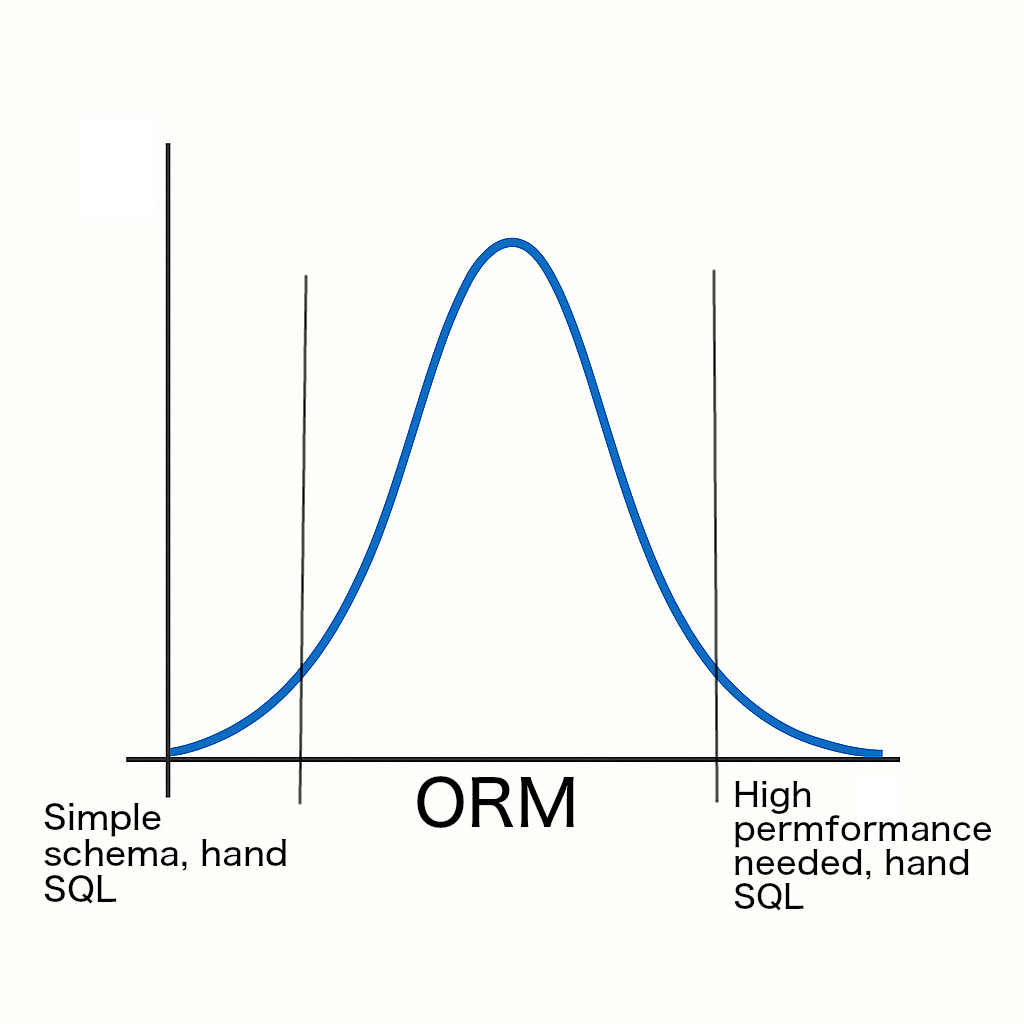
<p><img src="/assets/posts/2025-06-29-brooms-vs-vacuums-when-to-use-an-orm/bellcurve.png" alt="Bell curve about when to use an ORM vs hand SQL" width="512" height="512" /></p>

<p>When I worked at <a href="https://www.syncplicity.com/">Syncplicity</a>, we decided to refactor the desktop client to use <a href="https://sqlite.org/">SQLite</a> without an ORM. Initially, this decision was mildly controversial: When I joined the company, the desktop client used a very early version of <a href="https://nhibernate.info/">NHibernate</a>; but it performed poorly because it used NHibernate incorrectly.</p>

<p>I pointed out to my team members some important facts:</p>

<ul>
  <li>We had so few tables in our schema, and so few queries, that learning to use NHibernate correctly would take more time then just writing some queries by hand.</li>
  <li>All newcomers to our team would need to invest time in learning how to use NHibernate</li>
  <li>NHibernate’s binary was many times larger than our binary</li>
</ul>

<p>The problem that Syncplicity had with NHibernate was that the desktop client treated its SQLite database as a large, in-memory data structure. This is not how databases, and thus ORMs, are designed to work! As a consequence, the Syncplicity Desktop client performed very poorly whenever it used the database. This was not NHibernate’s fault, as their documentation explicitly stated not to use it to treat a database as a large, in-memory data structure. The problem was that, in order to use the database correctly, everyone had to first learn how to program with a database, and then learn how to use NHibernate correctly. The challenge with NHibernate (and most ORMs in general) is that it takes more time to learn how to use the ORM <em>correctly</em> than it takes to write a handful of simple database queries. (And, remember that you still need to know how to program with a database in order to use an ORM. You can’t just introduce an ORM to a product as a replacement for requiring that your engineers know how to use a database.)</p>

<p>The decision to remove NHibernate was correct: Later, newcomers to the team appreciated that we had a small amount of very simple database code that was easy to learn, and easy to maintain. As we went through acquisitions, we didn’t need to “defend” NHibernate to each parent company’s legal team. (Each company that acquired us did its due diligence and audited our 3rd party dependencies) We also didn’t need to worry about <a href="https://www.cvedetails.com/cve/CVE-2024-39677/">NHibernate’s security vulnerabilities</a>. We never switched from SQLite to another database, but if we did, there was so little “database” code that rewriting it wouldn’t have taken a lot of time. (And finally, our application size was significantly smaller.)</p>

<p>It would be a different case if the Syncplicity Desktop client had a more complicated schema and/or made significantly more database queries. In that case, the learning curve, and the implicit cost of a 3rd party library, would have been “worth it.”</p>

<p>After Syncplicity, I joined <a href="https://www.optirtc.com/">OptiRTC</a>. Our backend service probably has in excess of 100 tables, and there are probably at least 1000, if not more, queries. We also run a lot of ad-hoc queries using <a href="https://www.linqpad.net/">LINQPad</a>. In our case, we use <a href="https://github.com/dotnet/efcore">Entity Framework</a>. Writing queries “by hand”, except in performance critical areas, is a “fools errand” for us due to our team size.</p>

<p>Entity Framework, with LINQPad, allows us to more easily write ad-hoc queries, and read the data, than we could using a traditional SQL console. Even if all application code used hand-written SQL, it would be “worth it” for us to create Entity Framework bindings merely to support LINQPad.</p>

<p>We do have some older code, written by junior programmers, that is sensitive to <a href="https://en.wikipedia.org/wiki/Cartesian_explosion">cartesian explosion</a>. This is a consequence of junior programmers not understanding the limits of ORMs in database programming.</p>

<p>In contrast to OptiRTC, a few years ago, one weekend I quickly made a proof-of-concept web application with a database. It had one or two tables, and a few queries. I believed that it would take me more time to set up Entity Framework than to just write queries by hand, so that’s what I did. Nothing ever came out of the weekend proof-of-concept; but if it did turn into a larger project, I would have included Entity Framework.</p>

<h2 id="its-not-hard-to-write-sql-queries-by-hand">It’s not hard to write SQL queries by hand</h2>

<p>… it’s just time consuming to construct and populate your data structures!</p>

<p>SQL is a very simple language: Any competent programmer can learn to write basic CRUD queries. Joins and aggregations are also techniques that any competent programmer can learn. Writing the corresponding data structures and population logic that uses a data reader is also basic programming; any programmer who can solve <a href="https://en.wikipedia.org/wiki/Fizz_buzz#Programming">Fizzbuzz</a> or pass a basic data structures class should be able to do this.</p>

<p>The issue is that this is time consuming code to write! Using Entity Framework, I can write a query with complicated joins, and get back fully-populated objects, in a matter of minutes. A query with complicated joins, when written by hand, and when the objects are populated by hand, can take hours, if not longer, to implement.</p>

<p>The difference is in optimization, debugging, and working around bugs in 3rd party libraries. Much like how a vacuum can malfunction in ways that a broom never will, an ORM can malfunction in ways that hand-written SQL and hand-written object population code will never malfunction. When implementing a complicated application with lots of tables, relationships, and queries, an ORM will save significant time. In contrast, using a broom, IE, writing queries by hand, is mostly only “worth it” when setting up and learning to use the ORM correctly takes more time than writing the query, or for queries with significant performance needs.</p>

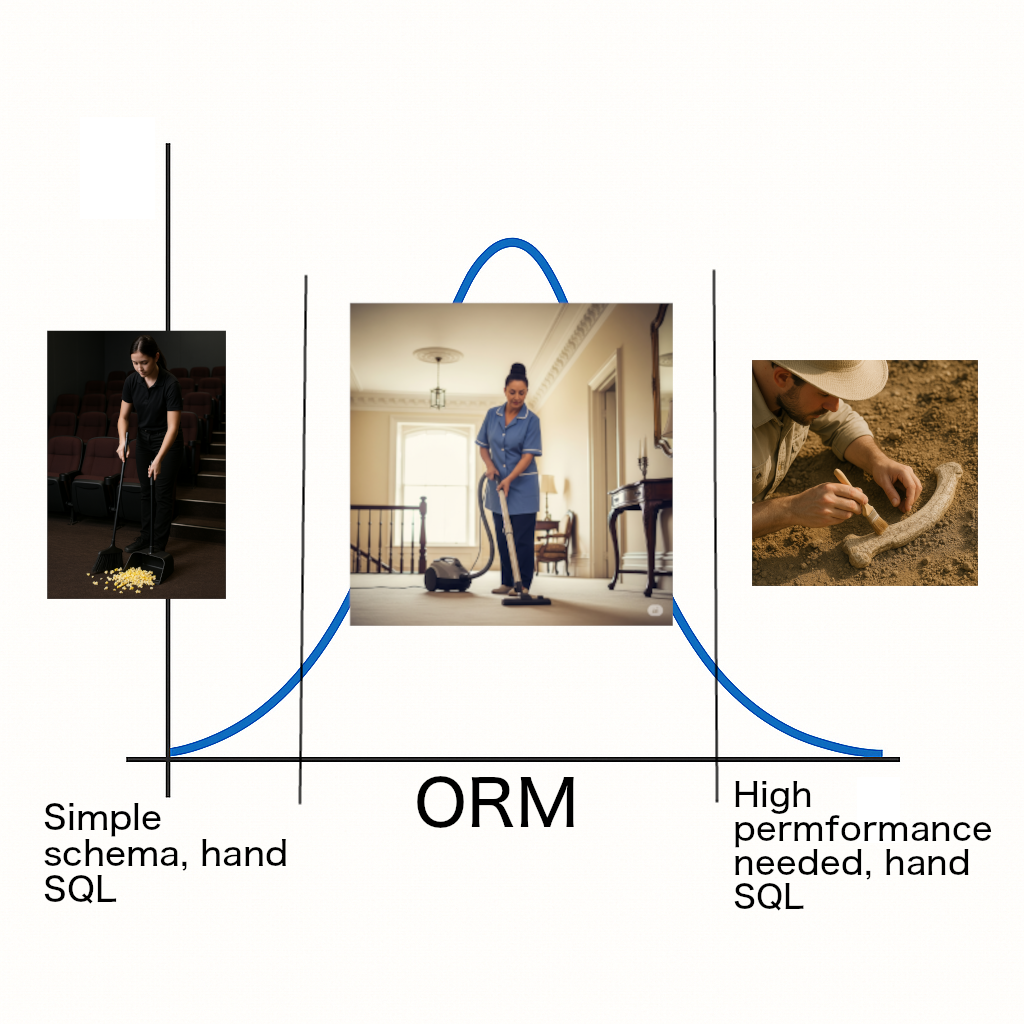
<p><img src="/assets/posts/2025-06-29-brooms-vs-vacuums-when-to-use-an-orm/bellcurvewithoverlays.png" alt="Bell curve about when to use an ORM vs hand SQL, with overlays of brooming and vacuuming" width="512" height="512" /></p>

<h2 id="when-using-a-database-do-you-need-a-broom-or-a-vacuum">When using a database, do you need a broom or a vacuum?</h2>

<p>When deciding between an ORM or hand-written queries, I like to think of three categories:</p>

<ol>
  <li><strong>Broom because of simplicity</strong>: The database has few tables and simple query needs. I will skip the ORM because I’ll never “break even” on the time it takes to set it up and learn how to use it correctly.</li>
  <li><strong>Vacuum because of breadth</strong>: The database had many tables and queries. I will “break even” on the time it takes to pick an ORM, set it up, learn how to use it correctly, work around its bugs, react to its security vulnerabilities, and defend its license to the company’s legal team.</li>
  <li><strong>Archeologist’s paintbrush because of specialization</strong>: The application has “hot” queries, is performance sensitive, or otherwise needs every kind of performance boost it can get. In this case, it’s “worth it” to invest the time and or manpower into hand-writing optimized queries and code to populate objects.</li>
</ol>

<hr />

<h2 id="appendix-the-tragedy-of-vmwares-capacity-planner-rewrite">Appendix: The Tragedy of VMWare’s Capacity Planner rewrite</h2>

<p>In 2007, I joined VMware to work on the Capacity Planner tool. We were rewriting it in C# with NHibernate as the ORM around the <a href="https://www.firebirdsql.org/">Firebird database</a>. The project ultimately was a failure, and never shipped.</p>

<p><strong>The primary cause of the failure</strong> was a belief that an ORM, like NHibernate, was enough to compensate for developers not knowing how to use a database, or to even think about the correct design patterns to use when programming with a database. Internally, the Capacity Planner tool treated the database, through NHibernate, as a large in-memory data structure. It performed very poorly, primarily because it encountered the <a href="https://stackoverflow.com/questions/97197/what-is-the-n1-selects-problem-in-orm-object-relational-mapping">N+1 problem</a>.</p>

<p>The Capacity Planner had a very simple database schema, about 10 tables if I remember correctly. It was simple enough that a broom (no ORM) could have been enough. Instead of recognizing and fixing the problem, (either by writing queries by hand or learning to use NHibernate correctly), the team decided to implement a complicated scalability layer and “scale out” the tool. This added significant development complexity, and if the tool ever shipped, significant deployment complexity.</p>

<p>To rephrase, the “scale out” approach the team took to the performance problems was significantly more complicated than simply optimizing the Capacity Planner’s data access layer.</p>

<p>This mistake was made before I joined the team, yet it took me some time to understand the problem. At the time, I was early in my career and trying to learn from people who I believed were more experienced than me.</p>

<p>After I was on the team for about a year, I encountered a problem. One day, while testing, the Capacity Planner became so bogged down that my hard drive started clicking like crazy. (This was 2008 when we still had mechanical hard drives.) There were probably only a few thousand rows in the database, so this behavior was unexpected, and obviously incorrect.</p>

<p>The next day I spent some time researching how to use NHibernate correctly, and realized that:</p>

<ol>
  <li>The way we were using it, as a large, in-memory data structure, was incorrect.</li>
  <li>NHibernate was way too complicated of a tool to use with such a simple schema.</li>
</ol>

<p>I tried to discuss this with the team’s architect, but he told me that, to paraphrase, “ORMs are the modern way to use a database, and we shouldn’t have to think about the database.”</p>

<p>It then became clear why the Capacity Planner project failed:</p>

<ol>
  <li>The team leadership believed that ORMs were a replacement for knowing how to program a database. (They are a tool for people who already know how to use a database, and have their own learning curve.)</li>
  <li>The Capacity Planner had unprofessionally poor performance because the lead developers (before I arrived) did not know how to program with a database.</li>
  <li>The team tried to compensate with an ambitious “scale out” approach.</li>
  <li>The “scale out” approach was more complicated, fragile, and time consuming than merely learning how to use a database, and either write the queries by hand, or learn how to use NHibernate correctly.</li>
</ol>

<p>Instead, had the leadership taken the “broom vs vacuum” philosophy, they would have started “at day one” requiring that the team members learn how to program with a database correctly. They also would have made an informed decision about if NHibernate was really needed, because the schema itself was so simple that it was hard to justify that added overhead of an ORM.</p>]]></content><author><name></name></author><category term="programming" /><category term="databases" /><category term="orm" /><summary type="html"><![CDATA[One rather frustrating topic issue that I’ve encountered as a software engineer is the groupthink around using an Object-Relational Mapper (ORM). Some people don’t understand the tradeoffs of using an ORM, vs writing data access code by hand. As a result, they can’t comprehend why someone would write their own queries or populate their own objects.]]></summary></entry><entry><title type="html">Takeaways from the Trump Tariffs</title><link href="https://blog.andrewrondeau.com/politics/king/trump/tariffs/2025/04/06/takeaways-from-the-trump-tariffs.html" rel="alternate" type="text/html" title="Takeaways from the Trump Tariffs" /><published>2025-04-06T00:00:00+00:00</published><updated>2025-04-06T00:00:00+00:00</updated><id>https://blog.andrewrondeau.com/politics/king/trump/tariffs/2025/04/06/takeaways-from-the-trump-tariffs</id><content type="html" xml:base="https://blog.andrewrondeau.com/politics/king/trump/tariffs/2025/04/06/takeaways-from-the-trump-tariffs.html"><![CDATA[<p>Here are some things we should take away from the Trump Tariffs:</p>

<ul>
  <li>
    <p><strong>The President has far too much power to apply tariffs</strong>. The US government is supposed to be structured with checks and balances. No President should be able to restructure our economy without involving Congress. (As many economists point out, it will take longer to move factories and shift supply chains than the remainder of Trump’s presidency, and the next president could eliminate the tariffs.)</p>
  </li>
  <li>
    <p><strong>Why aren’t we hearing complaints from the “cut taxes” crowd</strong>? Given that our current supply chains are import-heavy, the tariffs are essentially a major tax increase.</p>
  </li>
  <li>
    <p><strong>We really need to eliminate the border with Canada (and perhaps Mexico.)</strong> We have strong cultural and economic ties with both Canada. There are areas in the Northeastern US where roads were built when travel between the two countries was unrestricted.</p>
  </li>
  <li>
    <p><strong>What is Trump’s long-term plan?</strong> Some news articles point out that, before the income tax, the US government used to get its revenue from tariffs. Tariffs are similar to consumption taxes, which I generally prefer over income taxes. What is Trump’s plan for revenue generated from tariffs? Replace income tax? Cover Social Security shortfalls?</p>
  </li>
</ul>

<h2 id="focusing-on-the-us-canada-border">Focusing on the US Canada Border</h2>

<p>Many Americans forget that, at one time, the border between the US and Canada was more like crossing between states. There are country roads in the woods that now have roadblocks. Businesses and farms abut the border.
Some links about the absurdity of our shared border:</p>

<ul>
  <li><a href="https://www.youtube.com/watch?v=EocJm3Dry4E">The US-Canada border splits this road down the middle</a>. In this video, Tom Scott shows a road where one side is in Canada, and the other is in the United States. He points out that it is illegal to cross the street, and that the “Canadian” road might, technically be in the US.</li>
  <li><a href="https://en.wikipedia.org/wiki/Aroostook_Valley_Country_Club">The Aroostook Valley Country Club was historically accessed by a road in Maine, but resides almost completely in Canada. The Wikipedia page</a> explains the complexities of entering the golf course from both the US and Canada. When looking at <a href="https://maps.app.goo.gl/wWo9gZ3Z64octcuE8">https://maps.app.goo.gl/wWo9gZ3Z64octcuE8</a>, observe that the golf course is on Russel Road, in the US, and that slightly north is Brown Rd, which is in Canada.</li>
  <li><a href="https://en.wikipedia.org/wiki/Roxham_Road">Roxam Road</a>, <a href="https://maps.app.goo.gl/JZEzPJwEsHDak3kt5">https://maps.app.goo.gl/JZEzPJwEsHDak3kt5</a>, a rural road that predates the US-Canada border, is very controversial within Canadian politics. Currently, it is a source of illegal immigration into Canada from the US. In the past, it did not have customs and was used by bootleggers.</li>
</ul>

<p>The above links demonstrate that the US-Canadian border is quite arbitrary in an area where the border was imposed for political reasons.</p>

<h2 id="some-approaches-to-get-rid-of-the-us-canadian-border">Some Approaches to get rid of the US-Canadian border</h2>

<p><strong>What if Canada is the 51st state?</strong> What if each province becomes a state? Although we can laugh at the joke, it really puts shade on our attitude of American Exceptionalism. Although many Americans will admit that our government is dysfunctional, many of us are blissfully unaware that our democracy is outdated. Although Canada is a democracy, they operate their government differently than we do. To quote <a href="https://en.wikipedia.org/wiki/Canada">the Wikipedia page on Canada</a>:</p>

<blockquote>
  <p>Canada is a parliamentary democracy and a constitutional monarchy in the Westminster tradition.</p>
</blockquote>

<p>In contrast, the problems in our outdated democracy are explored in the book <a href="https://www.amazon.com/Breaking-Two-Party-Doom-Loop-Multiparty/dp/0190913851">Breaking the Two Party Doom Loop by Lee Drutman</a>. Part of the book explains how other democracies run their elections, and how that avoids the political gridlock and disfunction that we have.</p>

<p>I don’t think Canada wants to trade its form of government for ours.</p>

<p><strong>What about an EU-Style Union?</strong> Summaries on this topic on Wikipedia indicate that it has poor popularity: <a href="https://en.wikipedia.org/wiki/North_American_Union">https://en.wikipedia.org/wiki/North_American_Union</a> and <a href="https://en.wikipedia.org/wiki/North_American_monetary_union">https://en.wikipedia.org/wiki/North_American_monetary_union</a>. I wonder if Trump is trying to push this issue with jokes about the 51st state.</p>

<p><strong>What about a constitutional convention?</strong> Ultimately, the flaws <a href="https://www.amazon.com/Breaking-Two-Party-Doom-Loop-Multiparty/dp/0190913851">Drutman describes in “Breaking the Two-Party Doom Loop,”</a> and the fact that the president shouldn’t be able to impose so many tariffs without congress, demonstrate that we need to revise our constitution to be more in line with lessons learned from our history, and lessons learned from other democracies.</p>

<p>We could invite Canada to observe our own convention, and give them the option of joining.</p>

<h2 id="in-conclusion">In Conclusion</h2>

<p>In conclusion, Trump’s tariffs need to make us think more deeply about how much power we give the president, how we can eliminate our border with Canada, and how we can solve political problems in our own country.</p>]]></content><author><name></name></author><category term="politics" /><category term="king" /><category term="trump" /><category term="tariffs" /><summary type="html"><![CDATA[Here are some things we should take away from the Trump Tariffs:]]></summary></entry><entry><title type="html">Object Equality in C#</title><link href="https://blog.andrewrondeau.com/c%23/programming/2024/10/20/object-equality-in-c-sharp.html" rel="alternate" type="text/html" title="Object Equality in C#" /><published>2024-10-20T00:00:00+00:00</published><updated>2024-10-20T00:00:00+00:00</updated><id>https://blog.andrewrondeau.com/c%23/programming/2024/10/20/object-equality-in-c-sharp</id><content type="html" xml:base="https://blog.andrewrondeau.com/c%23/programming/2024/10/20/object-equality-in-c-sharp.html"><![CDATA[<p>In <a href="https://stackoverflow.com/a/54892972">“Object Equality in C#” on Stack Overflow</a>, I explained the different kinds of equivalence in programming, and how they are implemented in C#.</p>

<p>To summarize, in programming, there are four kinds of object equivalence:</p>

<ol>
  <li><strong>Reference Equality, object.ReferenceEquals(a, b)</strong>: The two variables point to the same exact object in RAM. (If this were C, both variables would have the same exact pointer.)</li>
  <li><strong>Interchangeability, a == b</strong>: The two variables refer to objects that are completely interchangeable. Thus, when a == b, Func(a,b) and Func(b,a) do the same thing.</li>
  <li><strong>Semantic Equality, object.Equals(a, b)</strong>: At this exact moment in time, the two objects mean the same thing.</li>
  <li><strong>Entity equality, a.Id == b.Id</strong>: The two objects refer to the same entity, such as a database row, but don’t have to have the same contents.</li>
</ol>]]></content><author><name></name></author><category term="c#" /><category term="programming" /><summary type="html"><![CDATA[In “Object Equality in C#” on Stack Overflow, I explained the different kinds of equivalence in programming, and how they are implemented in C#.]]></summary></entry><entry><title type="html">Interview Feedback to an Upcoming Computer Science Student</title><link href="https://blog.andrewrondeau.com/software/careers/interviewing/2024/03/05/interview-feedback-to-an-upcoming-computer-science-student.html" rel="alternate" type="text/html" title="Interview Feedback to an Upcoming Computer Science Student" /><published>2024-03-05T00:00:00+00:00</published><updated>2024-03-05T00:00:00+00:00</updated><id>https://blog.andrewrondeau.com/software/careers/interviewing/2024/03/05/interview-feedback-to-an-upcoming-computer-science-student</id><content type="html" xml:base="https://blog.andrewrondeau.com/software/careers/interviewing/2024/03/05/interview-feedback-to-an-upcoming-computer-science-student.html"><![CDATA[<p>Recently, I helped a friend screen a candidate for a software engineering role. The candidate was an undergraduate computer science student, expecting to graduate in a few months. Here is the feedback I sent them after the interview.</p>

<hr />

<p>Congratulations on completing your first Software Engineering job interview!</p>

<p>Normally companies don’t give feedback to candidates after interviews. I won’t explain why, but in this case, I hope I can help you land your first job.</p>

<p><strong>The most important thing you can do is practice programming 4-6 hours a day, 5 days a week, until you get your first job</strong>. You need to work out your brain like a muscle, and have a natural feel for programming. These workouts are needed in order to make it through a job interview and have the skills you need to do the job you are trying to get.</p>

<p>There’s two ways to get started:</p>

<ul>
  <li>
    <p>Do challenges on <a href="https://leetcode.com/">https://leetcode.com/</a>, <a href="https://adventofcode.com/">https://adventofcode.com/</a> or <a href="https://www.topcoder.com/community/practice">https://www.topcoder.com/community/practice</a>.</p>
  </li>
  <li>
    <p>Pick a programming project that you want to do, and do it. This can be a web application, game, or utility. For example, when I wanted to learn Node.js and brush up on web development, I wrote a blog engine: <a href="https://github.com/GWBasic/z3">https://github.com/GWBasic/z3</a>. Now that I’m trying to learn Rust, I’m writing a surround-sound upmixer: <a href="https://github.com/GWBasic/soft_matrix">https://github.com/GWBasic/soft_matrix</a></p>
  </li>
</ul>

<p>In general, the above activities should be for fun and to “build your programming muscles.” You need these programming muscles to make it through a typical job interview. Don’t worry about being too ambitious, either. The experience is more important than starting a project you’ll never finish.</p>

<p><strong>The second most important thing you can do is be patient</strong>. When I graduated, it took me 4 months to find a job. I even worked at a Best Buy for 2 weeks for “beer money.” More recently, in 2020 I applied to 57 jobs over a 20 week period. I chose where I applied carefully, (but I was open-minded about where I applied and didn’t SPAM my resume.)</p>

<p>The pattern that I followed was:</p>

<ul>
  <li>At the beginning of the month I applied to about 10 jobs</li>
  <li>For the rest of the month I worked on my skills</li>
  <li>I scheduled callbacks, screenings, ect, throughout the rest of the month</li>
</ul>

<p>(Also, don’t forget that you’re going to work for 40+ years, so if you need a vacation or otherwise want to do something that’s hard to do while you have a full-time job, do it now!)</p>

<p>When job interviews come your way, take them even if you don’t think you can get the job! It’s better to flub up on an interview for a job that you don’t think you can get; and use that as practice for the job interview that you really want!</p>

<p><strong>Third, your college’s career office doesn’t know much about interviewing for software jobs:</strong></p>

<ul>
  <li>Very few software developers wear suits and ties to job interviews.</li>
  <li>Use nuance when saying “I can learn” at the end of an interview</li>
</ul>

<p>If you don’t like wearing suits, consider:</p>

<ul>
  <li>Skip the tie, but keep the shirt and the button-down shirt</li>
  <li>A suit with a high-quality shirt without a collar, like a turtleneck, or solid colored t-shirt</li>
  <li>A high-quality button down shirt without the coat (useful on hot days.)</li>
  <li>Or, have fun with the suit! It doesn’t need to be a conservative suit. Have some fun with the shirt and tie if you want to.</li>
</ul>

<p>In general, you should feel comfortable, both physically and emotionally, with what you wear. (Just don’t show up in a grubby t-shirt or a bargain basement polo shirt.)</p>

<p>The “Say ‘I can learn’” advice doesn’t really work in software interviews. It’s much more important to be comfortable programming, and have a good rapport with your interviewer(s). I can explain the nuance better on the phone if you’d like me to.</p>

<p><strong>Finally, it’s okay to decide that you don’t like programming, and choose to follow a different career</strong>. Your degree can be used in careers that don’t require as much programming: Quality Assurance, Sales, Support, Customer Development, the list goes on. There are also jobs that just want any college degree, like Enterprise Rent-A-Car. And, there are science research jobs where you will do a small amount of programming, but the focus is on the science and research.</p>

<p>So, in conclusion, I wish you a lot of luck in your early career!</p>

<hr />

<p>Regarding my comments about the “Say ‘I can learn’” interview technique:</p>

<p>(Context: Some job interviewing clinics advise candidates that, if they think the interview is going poorly, to say something like, “I know I didn’t answer this question well, but I can learn.”)</p>

<p>I didn’t want to extrapolate on this technique in the email, because I didn’t want the feedback to be taken personally.</p>

<p>In this case, the candidate struggled with very basic programming concepts; concepts that they should know before they start the job. My interviewing style is to give the candidate all instructions they need for the task to perform in the interview; if they can’t perform the task, they haven’t demonstrated that they “can learn.”</p>

<p>I told the candidate to “call the method on the object, put the result in a variable, and then pass it to the constructor.” These are fundamental tasks in programming, and any Computer Science graduate should be 100% comfortable doing them. This is why I suggested that the candidate practice 4-6 hours a day.</p>

<p>In general, in a software engineering interview, the candidate is being screened to determine if they have the needed skills for the job. If they don’t have the skills for the job, it’s much easier (for the company) to interview another candidate than to spend months, or years, training the candidate. This is especially the case with junior developers, where there is a huge risk that they will not develop the skills needed to do the job.</p>

<p>The problem is, when a candidate uses the “Say ‘I can learn’” technique in an software engineering interview, it shows that the candidate doesn’t understand the fundamental requirements of the job.</p>

<p>Instead, it’s best that the candidate thank the interviewer, ask for suggestions on skills to work on, and continue to keep searching.</p>]]></content><author><name></name></author><category term="software" /><category term="careers" /><category term="interviewing" /><summary type="html"><![CDATA[Recently, I helped a friend screen a candidate for a software engineering role. The candidate was an undergraduate computer science student, expecting to graduate in a few months. Here is the feedback I sent them after the interview.]]></summary></entry><entry><title type="html">So you want me to be your technical co-founder?</title><link href="https://blog.andrewrondeau.com/software/careers/startup/2023/07/05/so-you-want-me-to-be-your-technical-co-founder.html" rel="alternate" type="text/html" title="So you want me to be your technical co-founder?" /><published>2023-07-05T00:00:00+00:00</published><updated>2023-07-05T00:00:00+00:00</updated><id>https://blog.andrewrondeau.com/software/careers/startup/2023/07/05/so-you-want-me-to-be-your-technical-co-founder</id><content type="html" xml:base="https://blog.andrewrondeau.com/software/careers/startup/2023/07/05/so-you-want-me-to-be-your-technical-co-founder.html"><![CDATA[<p>I’ve talked to a lot of people who really need a technical co-founder. Unfortunately, people who have a grand idea, but can’t do the programming or engineering, are a dime a dozen.</p>

<h2 id="are-you-a-clown-do-you-have-a-good-idea-and-understand-the-risks">Are You a Clown? Do You Have a Good Idea and Understand the Risks?</h2>

<p>So let’s say we’ve met, talked for an hour, what goes through my head? I’m trying to figure out if you’re a clown, whose idea is so grand that it’s biggest value is entertainment and laughs. Most people who I talk to, unfortunately, are clowns! Don’t feel bad if you realize that you’re just clowning around instead of building a sustainable technology business. Every successful entrepreneur has been a clown at one point or another. I certainly have. I’m sure you don’t have to think very hard to find examples of Steve Jobs, Bill Gates, Mark Zuckerberg, Elon musk, or Jack Dorsey being a clown.</p>

<p>Why would I think you’re a clown? Maybe you are trying to build a business that would try to compete with a company like Apple on a shoestring budget. Maybe you are doing something silly, like putting the engineering before finding a good solution to your problem, like a guy who I met who wanted to build a modular car that would seat either one person or have a clip-on module to seat six people. Maybe, your management philosophy seems a too hard to work with. Maybe you’ve cornered me at a networking event and tried to chew my ear off with ridiculous ideas because your Adderall prescription is too strong. Maybe you want to build a submarine with a carbon-fiber hull, and just won’t listen to reason.</p>

<p>I hope you realize that the odds are against you. All high-tech startups are, at some point, an odds game. Unfortunately, it’s difficult to know the odds going in, but if you don’t seem to have a good understanding of the odds: you’re a clown. An important part of running a high tech startup is managing your risk to keep the odds in your favor.</p>

<h2 id="will-you-expect-me-to-work-for-sweat-equity-only">Will You Expect Me To Work For Sweat Equity Only?</h2>

<p>So now let’s assume that I’ve decided you’re not a clown: Your idea is solid, you’re a reasonable person, (IE, you’re not building a submarine with a carbon-fiber hull,) and you understand how to manage your risk. The next thing that I’m going to look for is, is your idea interesting to me? If it’s not, don’t feel bad. There’s a lot of high-tech startups that just have no appeal to me whatsoever, but probably could be very successful.</p>

<p>So now let’s assume that you’re not a clown, and you’re working on something that is interesting to me. I bet you’re going to want me to quit my job right? I’m probably going to tell you my current salary and say that I can’t quit my job unless you can pay me. I hope you realize this is a bluff, sort of. Before I explain why, I will eventually be willing to quit my job and go a period without income. I’m not ready to put “sweat equity” on the table… yet.</p>

<p>Why am I so fixated on money? There’s many reasons. Remember how I mentioned that in high tech startups, it’s an odds game and the odds are against you? It’s extremely hard for me to play the odds. Chances are I have a well-paying job that I like, (unless I am between jobs.) It probably took me a lot of time to find my job and get to a good amount of respect and clout in my organization. I’m not going to squander such a position unless I am fairly certain that I the startup will “work out” for at least two years. One way to do that is to have income at day one. I’m at a stage in my career where being on the job market is unpleasant. (Why? I’ve been around the block a few times and I have very tolerances for poorly managed engineering groups.)</p>

<p>But I know the startup game, I know that it is very difficult, or impossible, to raise enough money to pay me the salary I want very early in the lifetime of a company. I know that what I ask is almost impossible, which is why I say it’s a bluff, sort of.</p>

<p>I have quit my job before to try and run a company, so I know what it’s like to chase my dream on no income. I have no intention of chasing <em>your</em> dream. That’s why I bluff about the money. It’s a control thing. Specifically, it’s about your control about what we are building.</p>

<h2 id="will-you-be-willing-to-give-me-creative-control-in-return-for-my-sweat-equity">Will You Be Willing to Give Me Creative Control in Return for my Sweat Equity?</h2>

<p>If you want me to quit my job, to be a technical co-founder, you need to be extremely flexible about what we’re building! One thing that I’ve encountered over and over is that someone is so rigid in what they are trying to build, that it will only work out if it’s an employer employee relationship. In that situation, I will happily take whatever title you want to give me and do my best to build whatever you want! After all I’m getting paid! As long as the money lasts for a few years, I’m willing to take a chance on you.</p>

<p>But chances are that you have very little money and very little resources.</p>

<p>The only way we are going to be able to build a company is if you trust me to take your ideas and research and figure out how to do it on a shoe-string budget with no resources. This is going to require an extremely high amount of flexibility on your part: You will need to trust me completely and let go of control over the product. There are many areas of the business that I will have minimal control over too, but I trust that you will do your part.</p>

<p>Why? Engineering is always about compromises.</p>

<p>I will probably compromise the product based on my comfort level about working with certain technologies. You might think, “oh well, I’m going to keep looking until I can find someone who is going to build every detail exactly to my specification, purely for equity.” You might get lucky, but I think you will miss your market window before you find such a person. I encourage you to compromise your dreams with pragmatism and let me riff on your ideas: An MVP is always a compromise.</p>

<h2 id="can-we-trust-each-other-enough-to-collaborate-versus-fight-for-control">Can We Trust Each Other Enough to Collaborate Versus Fight for Control?</h2>

<p>We need to be able to develop a great rapport where I trust that you to do your part in building a great company. It’s more than you being an awesome salesman or an awesome procurement person, or awesome marketing. The only way we can build this rapport is by spending time together; where I can figure out how to build something that balances:</p>

<ul>
  <li>Your vision</li>
  <li>The very short time we have to build an MVP</li>
  <li>What is buildable in that time.</li>
</ul>

<p>It’s only when we can build the rapport that we can discuss me working for sweat equity. Without such a rapport, I’m going to hold firm that I need income.</p>

<p>To summarize: if you want me to be your technical co-founder, and you’re not a clown, and you want me to quit my job, and you can’t pay me the salary I want, we’re going to have to make a compromise. You’re going to have to give up the control over the product and give me a lot of your attention. In return, I can guarantee you that I will get as close to your vision as I reasonably can.</p>]]></content><author><name></name></author><category term="software" /><category term="careers" /><category term="Startup" /><summary type="html"><![CDATA[I’ve talked to a lot of people who really need a technical co-founder. Unfortunately, people who have a grand idea, but can’t do the programming or engineering, are a dime a dozen.]]></summary></entry><entry><title type="html">How to get a stack trace of a background thread in .Net</title><link href="https://blog.andrewrondeau.com/software/development/stacktrace/c%23/2022/02/04/how-to-get-a-stack-trace-of-a-background-thread-in-net.html" rel="alternate" type="text/html" title="How to get a stack trace of a background thread in .Net" /><published>2022-02-04T00:00:00+00:00</published><updated>2022-02-04T00:00:00+00:00</updated><id>https://blog.andrewrondeau.com/software/development/stacktrace/c%23/2022/02/04/how-to-get-a-stack-trace-of-a-background-thread-in-net</id><content type="html" xml:base="https://blog.andrewrondeau.com/software/development/stacktrace/c%23/2022/02/04/how-to-get-a-stack-trace-of-a-background-thread-in-net.html"><![CDATA[<p>This blog entry is a response to a question I got in a stack overflow post: <a href="https://stackoverflow.com/questions/285031/how-to-get-non-current-threads-stacktrace">How to get non-current thread’s stacktrace?</a> [In C# / .Net] Specifically, I was asked if there were alternatives to the originally-obsolete solution: <a href="https://stackoverflow.com/questions/285031/how-to-get-non-current-threads-stacktrace/9595704?noredirect=1#comment125211968_9595704">https://stackoverflow.com/questions/285031/how-to-get-non-current-threads-stacktrace/9595704?noredirect=1#comment125211968_9595704</a>.</p>

<p>The author of the solution, who also writes the renowned <a href="https://www.linqpad.net/">LINQPad</a>, recently revised his answer. I’d use care with following Joe’s suggestion in shipping code, because what works correctly in a tool like LINQPad may not be appropriate for the environment that your application runs in. Specifically, Joe’s suggestion may not work in the various sandboxes, non-admin, ect, environments that .Net applications frequently run in.</p>

<p>A bit about my background. For almost a decade I was the desktop client lead for Syncplicity, a file synchronization product similar to Dropbox, OneDrive, and Google drive. While I led the desktop client, we were the most performant and scalable product on the marketplace. The desktop client was a highly multi-threaded C# desktop application. I have quite a lot of experience developing and debugging multithreaded .Net applications.</p>

<p>I’m assuming the person who asked me for alternatives to getting another thread’s stack trace wants to log collect debugging information; or otherwise needs to fix some threading issues.</p>

<h2 id="is-the-stack-trace-for-logging">Is the Stack Trace for Logging?</h2>

<p>I wish in .Net that it was very easy to get another thread’s stack trace, because then it would be significantly easier to diagnose certain kinds of bugs like deadlocks and other situations where a thread is blocked. Then it would be easier to include defensive “bug detector” code to log what a thread is doing if it holds a lock for too long! Depending on your application’s environment, you can’t always create a process to obtain a stack trace.</p>

<p>Unfortunately, the quick answer to “are there alternatives”, is that a multithreaded application needs a good logging strategy. The logger should always include the thread name, and thread ID. If you use async code, include Task.CurrentTaskId. Multi-server applications will also need to include the process ID, and the server instance number. Log4net can be configured to include these. Do not configure the logger to include stack traces, except in controlled debugging environments, because logging stack traces in every logging statement incurs extreme CPU overhead and performance will suffer.</p>

<p>When examining logs, filter based on the thread ID, or Task.CurrentTaskId for async code. (And filter on machine ID and process ID for distributed code). This will provide a sequential list of each logging event from the thread. It may be necessary to add logging statements in troublesome areas of code to give yourself hints about what to search for in your logs.</p>

<p>It may be <em>occasionally</em> useful to include a stack trace (Environment.StackTrace) in carefully selected logging statements. Consider restricting logging stack traces to either debug builds or via some kind of a configuration setting. (Remember, logging a stack trace incurs a high performance penalty.)</p>

<p><strong>Important</strong>: Any kind of logging, especially stack trace logging, will change timing of race conditions and deadlocks. Assuming that your bug is some kind of a threading issue, the logging you add could trigger a “Fermi’s paradox” situation where you either reproduce the bug more, or less frequently, based on how you log!</p>

<p>If you are directly creating threads, it’s very useful to name your threads, and include the thread name in your logs. This makes it very easy to track down the specific thread in your log.</p>

<p>If you are able to reproduce your problem when running your code inside of the Visual Studio debugger, when you break into the debugger, you can see a list of all your threads (and tasks). This also allows you to see each thread’s stack trace! (Yay!) Assuming that you’re logging the thread ID (and/or task Id), it should be very easy to find the specific thread that you are trying to debug.</p>

<h2 id="some-other-helpful-multithreaded-techniques">Some Other Helpful multithreaded Techniques</h2>

<p>If you are having problems with deadlocks or general threading issues, here are some additional strategies:</p>

<ul>
  <li>If you have a critical method that has a lot of callers, and could block for too long, add a string argument to the method. Give each call to the method a unique name. In your method, set a timer to log the string if the call takes longer than what you consider reasonable.</li>
  <li>Encapsulate your shared state so that it is prohibitively difficult to access it outside of a lock. For example, your shared state could be encapsulated in an object that is only accessible through a lambda. Then the object should have protections that prevent calling it from a different thread or holding on to the object outside of the lambda.</li>
  <li>Take the time to learn about programming with immutable values. If you have shared state, but the object itself is immutable, then it’s safe to read from any thread without a lock. (Your code still needs to handle stale state.)</li>
  <li>If you are having problems with deadlocks, consider replacing the lock keyword with a pattern that includes timeouts. These exceptions can help you diagnose deadlocks, or at a minimum, allow you to gracefully recover from such a situation. For example: <a href="https://github.com/GWBasic/ObjectCloud/blob/master/Server/ObjectCloud.Common/Threading/TimedLock.cs">https://github.com/GWBasic/ObjectCloud/blob/master/Server/ObjectCloud.Common/Threading/TimedLock.cs</a></li>
</ul>

<h2 id="dont-make-novice-mistakes">Don’t Make Novice Mistakes</h2>

<p>Now if you are trying to get a thread stack trace because you need to communicate among threads or wait for a thread to get into a particular state…Well… That’s a novice mistake! (And depending on what you’re doing, it might be time to admit you’ve gotten over your head!) Locking, monitors, wait handles, task completion sources, queues, fibers, mutexes, semaphores, critical sections, and other ways of coordination among threads are advanced programming techniques. Although I encourage you to learn, I really do recommend that you have a couple of years experience under your belt, or be in a more advanced computer science class, before you do multi-threaded programming in a professional setting.</p>

<h2 id="ok-but-really-is-there-a-way-to-get-another-threads-stack-trace-without-creating-another-process">Ok, but, really, is there a way to get another thread’s stack trace? (Without creating another process)</h2>

<p>But if you really need to get another thread’s stack trace at runtime when you don’t have a debugger available, this is prohibitively difficult. I will try to explain why to the best of my ability.</p>

<p>I’m going to assume that you know a decent amount of multi-threaded programming, and that sharing state, specifically data structures, among running threads is very difficult. One thread just can’t safely read another thread’s data structures unless they are designed to be thread-safe; or locking is used. Often, allowing one thread to read another thread’s state incurs a performance penalty. An experienced software engineer can weigh the performance trade-offs of different approaches, such as locking versus lock free data structures. It’s my professional opinion that designing .Net’s stack so that a stack trace can be read in a non-blocking manner will cause a prohibitive performance degradation to the entire .Net framework.</p>

<p>This is why a thread needs to be suspended in order to get its stack trace from another thread. Why calling something like Thread.Suspend is problematic is more difficult for me to explain, because I have never worked with the internals of .net and the operating system. This response probably explains it best: <a href="https://stackoverflow.com/a/3602878/1711103">https://stackoverflow.com/a/3602878/1711103</a>.</p>

<p>I do suspect that a very talented programmer could figure out how to modify .Net to allow getting other threads’ stack traces at runtime without relying on an additional process. (After all, the garbage collector does walk the stack!) It would be very interesting to hear from one of Microsoft’s developers to know if this is feasible, and what kind of tradeoffs this would incur.</p>

<h2 id="conclusion">Conclusion</h2>

<p>So there you have it: Use a logging strategy that includes information about each thread. Try to reproduce the bug inside a debugger, because the debugger will give you the stack trace of all threads. Make sure you have the experience to implement multi-threaded programming correctly. (Or be willing to admit that you’ve gotten over your head.) Given that .Net’s garbage collector walks threads’ stacks, I do wish that .Net allowed getting another thread’s stack trace for diagnostic purposes.</p>]]></content><author><name></name></author><category term="software" /><category term="development" /><category term="stacktrace" /><category term="c#" /><summary type="html"><![CDATA[This blog entry is a response to a question I got in a stack overflow post: How to get non-current thread’s stacktrace? [In C# / .Net] Specifically, I was asked if there were alternatives to the originally-obsolete solution: https://stackoverflow.com/questions/285031/how-to-get-non-current-threads-stacktrace/9595704?noredirect=1#comment125211968_9595704.]]></summary></entry><entry><title type="html">Why Software Engineers Don’t Respond to Recruiters</title><link href="https://blog.andrewrondeau.com/software/careers/recruiters/spam/2022/02/04/why-software-engineers-dont-respond-to-recruiters.html" rel="alternate" type="text/html" title="Why Software Engineers Don’t Respond to Recruiters" /><published>2022-02-04T00:00:00+00:00</published><updated>2022-02-04T00:00:00+00:00</updated><id>https://blog.andrewrondeau.com/software/careers/recruiters/spam/2022/02/04/why-software-engineers-dont-respond-to-recruiters</id><content type="html" xml:base="https://blog.andrewrondeau.com/software/careers/recruiters/spam/2022/02/04/why-software-engineers-dont-respond-to-recruiters.html"><![CDATA[<p>It’s well-known in the software engineering field that it’s hard to recruit software engineers. Once, a recruiter once complained to me that most software engineers ignored introductory emails. (In contrast, they told me that typically other professions have a much higher success rate.)</p>

<p>I will try to explain why most software engineers ignore recruiters.</p>

<p>TLDR: Most of the time, responding to a recruiter ends up being a waste of my time: The recruiter stops responding, the interview stinks, or I end up not wanting a job. The job market is too frustrating to interact with recruiters unless I am actively looking for a job.</p>

<h2 id="recruiter-spam">Recruiter SPAM</h2>

<p>I get a lot of spam from recruiters who never read my resume. These generally fall into these categories</p>

<ol>
  <li>Unskilled office work that involves a computer</li>
  <li>Jobs that I am qualified for, but require relocation</li>
  <li>Jobs where I have little experience in the technology stack</li>
</ol>

<p>In all cases, I wonder if anyone actually looked at my resume before sending me an email.</p>

<p>These emails aren’t “honest mistakes,” either. They are clearly widely sent out, and lead me to believe that someone is just sending out hundreds or thousands of emails without checking that the people they are sending them to are good matches.</p>

<p>This is a problem. SPAMming job postings to a poorly chosen audience is merely recruiters pushing their work onto others. Reviewing resumes is work, and it takes a lot of work on the part of a recruiter to find appropriate candidates. When I’m a job seeker, reviewing job postings is quite time consuming. Recruiters shouldn’t push their job into my inbox.</p>

<p>Unfortunately, the SPAMiness of recruitment emails makes me less likely to respond to a recruiter who has personally reviewed my resume or LinkedIn profile.</p>

<p>How to fix this:</p>

<ul>
  <li>Review the resume and/or Linkedin profile of each candidate you approach</li>
  <li>Make sure the outreach email contains some personal details that prove that you’re not SPAMing</li>
  <li>Only approach candidates who will need to relocate when there is a relocation package; and mention that package in the initial outreach email.</li>
</ul>

<h2 id="many-recruiters-are-difficult-to-work-with">Many Recruiters Are Difficult to Work With</h2>

<p>I’ve lost count of the number of times I’ve emailed back and forth with a recruiter, only for the thread to go cold with no response.</p>

<p>Some recruiters don’t understand the asynchronous nature of email, and request meetings, via email, on short notice.</p>

<p>Some recruiters call me while I’m in the middle of my job and expect me to drop what I’m doing to hear about their new job. (I no longer list my phone number on resumes.)</p>

<p>Often, it’s impossible to ask critical questions about the job.</p>

<p>Sometimes the recruiter’s initial email doesn’t provide any information about the job, beyond a vague location and the programming language. This is not enough information to decide if a job is worth applying for.</p>

<p>Many recruiters don’t know enough about software development to accurately match candidates to jobs. It ends up being guesswork for them, and it’s hard to know, when speaking with the recruiter, if I’m a good candidate.</p>

<p>How to fix this:</p>

<ul>
  <li>Never, ever, let an email thread drop. Politely end email threads when you will not continue with a candidate.</li>
  <li>Assume that candidates need 24 hours, or more, to respond to any email.</li>
  <li>Be knowledgeable about software development</li>
  <li>Never cold call software engineers</li>
</ul>

<h2 id="some-recruiters-are-just-ploys-to-collect-personal-information">Some Recruiters are Just Ploys to Collect Personal Information</h2>

<p>Recently (early 2022,) recruiters started contacting me on LinkedIn about “A Software Engineering Position in Boston, MA.” Instead of providing a link to a job description, the link is for me to sign up for a hiring network. There is always a claim that, if they find me interesting, they will follow up.</p>

<p>I always flag these as SPAM. I don’t believe that these recruiters represent real jobs.</p>

<p>I will not sign up for any website merely to read a job description. I also don’t want to join another career network. I’m already on LinkedIn and get plenty of emails outside of LinkedIn.</p>

<h2 id="recruiters-dont-know-the-rules">Recruiters don’t know “The Rules”</h2>

<p>In general, the way that hiring a software engineer works is:</p>

<ol>
  <li>An introductory phone call with the recruiter or hiring manager; or both</li>
  <li>A technical screening. This used to be a phone call, but it’s now evolved to use a web-based coding platform or screen sharing</li>
  <li>A full interview</li>
</ol>

<p>The purpose of the introductory phone call and technical screening is to ensure that there is mutual interest between the candidate and company; that the candidate is competent; and to confirm that the candidate has required technical background. Bypassing these (introductory call and screening) ends up wasting a lot of time, because for software engineering, most candidates fail. Either there isn’t mutual interest, or the candidates fail the technical screening.</p>

<p>I’ve encountered a few recruiters who ignore “the rules:”</p>

<ul>
  <li>In one case, the recruiter claimed, “we don’t get phone calls, we get interviews.” The “interview” was no different than a phone screen, and wasted my time due to travel.</li>
  <li>Another time I worked for a company where HR didn’t know “the rules” and scheduled day-long interviews with incompetent candidates. We could have saved these candidates their day off with a simple phone call.</li>
</ul>

<p>I’ve learned to keep these kinds of recruiters on a short leash, and either walk away or disengage.</p>

<p>How to fix this:</p>

<ul>
  <li>Be familiar with general industry best practices in hiring</li>
  <li>Don’t bypass critical parts of the hiring process: Determining mutual interest and introductory technical screenings save everyones’ time</li>
</ul>

<h2 id="i-wont-move">I Won’t Move</h2>

<p>Many recruiters approach me for jobs with absurd commutes, or for jobs that require that I relocate.</p>

<p>I’m no longer in my 20s, no longer single, and unable to move whenever I want to.</p>

<p>I live in a home that I built with the intention of living in it for a long time. I’m married to a wonderful wife who has her own career, I have kids, friends, and extended family. We aren’t going to move every time I change jobs.</p>

<p>I’ve been a telecommuter, with occasional office visits, since 2014. It’s worked out great, and the situation works out great for many other software engineers. When I see that a company is hostile to telecommuting, I interpret it as having control issues, or a desire to babysit.</p>

<p>How to fix this:</p>

<ul>
  <li>Make sure to map out how long it will take a candidate to commute to an office. (Google Maps lets you estimate travel time during different times of the day.)</li>
  <li>Make sure to acknowledge if a candidate will have to move, or have a commute longer than 30 minutes</li>
  <li>Explain telecommuting policies / relocation packages in the initial email</li>
  <li>Explain to employers that hybrid telecommuting is needed to widen the search radius to engineers who live too far away to commute</li>
</ul>

<h2 id="the-pay-is-probably-low">The Pay is Probably Low</h2>

<p>Software Engineering salaries are all over the place. I generally assume that most recruiters reaching out to me are trying to hawk lower-paying jobs.</p>

<p>With few exceptions, I will only pursue a job if I believe it will be a ~20% pay increase from my current job.</p>

<p>Software is an economic multiplier: I once heard that my 4 month project saved a company a million dollars a year. Because the software I write has substantial economic value, I expect a fair portion of the rewards.</p>

<p>How to fix this:</p>

<ul>
  <li>Only accept recruitment jobs that are at or above median pay</li>
  <li>Give a salary range in the initial outreach email</li>
  <li>Remember that software is an economic multiplier</li>
</ul>

<h2 id="interview-prep-and-take-homes-are-time-consuming">Interview Prep and Take Homes are Time Consuming</h2>

<p>I have firsthand experience interviewing candidates for software engineering positions. It’s greuling. A big problem, when hiring, is that most candidates who come into the interview aren’t capable of doing the job. Even worse, when we hire the wrong person, the situation becomes more frustrating and grueling than the interview process.</p>

<p>The industry handles this by attempting to carefully screen candidates, often through a series of take home exercises, detailed technical exercises to perform in the interview, and extensive interview preparation exercises.</p>

<p>Interview preparation and take-home exercises compete with the time I have for my family and other commitments. Interviews during business hours require that I fib to my current employer about my whereabouts.</p>

<p>How to fix this:</p>

<ul>
  <li>Make the job appealing before I need to invest precious time</li>
  <li>Have me meet with the hiring manager on the phone or videoconference before time consuming activities</li>
  <li>Make sure to explain this process in the initial contact email</li>
</ul>

<h2 id="the-company-probably-rejects-most-candidates">The Company Probably Rejects Most Candidates</h2>

<p>This isn’t something I admit that often.</p>

<p>Software engineering interviews are notoriously fickle, for so many reasons that I could write another article about all the problems I’ve encountered interviewing. In summary, for every good interview I’ve encountered, I’ve also had poorly explained questions, questions that require that I know some obscure algorithm, or interviewers who want to prove that they’re smarter than me. Sometimes I wonder if the interviewer has some bias.</p>

<p>When interviewing candidates, a common piece of wisdom is to reject when in doubt. I’ve interviewed a few “maybes” that I rejected. This is because it’s easier to “move to the next candidate” instead of putting up with a bad hire. I’ve also seen hiring an excellent candidate fall through because the hiring manager screwed up the process.</p>

<h2 id="aside-we-really-need-a-credentialing-process">Aside: We really need a Credentialing Process</h2>

<p>Many professions have a credentialing or licensing process to smooth over situations like this. My wife is a pediatrician, and the jobs she sees posted can only be applied to by credentialed pediatricians. She does not have to prove competency during the interview process.</p>

<p>Compared to interview prep, take-homes, or complicated interview questions, I’d much rather get credentials. It’s a better time commitment to earn credentials that I can use for any job interview; and it works out for the company’s favor because they don’t have to figure out if I’m competent.</p>

<p>How to fix this:</p>

<ul>
  <li>Try to find some kind of a proxy for credentials</li>
  <li>Recruiters: Develop your own technical screening process so you can screen a candidate once and let them interview at multiple companies</li>
</ul>

<h2 id="i-might-not-like-the-job--company">I Might Not Like the Job / Company</h2>

<p>Job interviews are a two-way street; I’ve bowed out of a few job interviews because I believed I wouldn’t like the job. Unless I’m desperate, I’m not going to risk leaving my current job if I have any suspicion that a job I’m interviewing for is going to be a difficult environment.</p>

<p>How to fix this:</p>

<ul>
  <li>Carefully screen the hiring managers that you recruit for</li>
</ul>

<h2 id="conclusion-lets-talk-the-odds">Conclusion: Let’s talk the odds</h2>

<p>When Syncplicity hired me, my manager told me that they phone screened 100 candidates, interviewed 10, and I was the first one they were comfortable hiring. (I then went on to make us an industry leader.) In my experience, this was accurate. We rejected many candidates on the phone screen, and many on the on-site.</p>

<p>Thus:</p>

<ul>
  <li><strong>Fail the interview</strong>: There is a 1% chance of getting an offer from a phone screen with a manager</li>
  <li><strong>Recruiter drops the ball</strong>: There’s a high chance a recruiter won’t respond back to me</li>
  <li><strong>Won’t accept the offer</strong>: There’s a high chance I won’t like the job, or the pay will be too low</li>
</ul>

<p>Thus, in my estimation, responding to a recruiter outreach has less than a 1% success rate for landing a job. It’s a fool’s errand.</p>

<p>That’s why software engineers don’t respond to recruiters. We have better things to do!</p>]]></content><author><name></name></author><category term="software" /><category term="careers" /><category term="recruiters" /><category term="spam" /><summary type="html"><![CDATA[It’s well-known in the software engineering field that it’s hard to recruit software engineers. Once, a recruiter once complained to me that most software engineers ignored introductory emails. (In contrast, they told me that typically other professions have a much higher success rate.)]]></summary></entry><entry><title type="html">Take-home vs whiteboard coding: The problem is bad interviews</title><link href="https://blog.andrewrondeau.com/interviewing/software/careers/2020/08/04/take-home-vs-whiteboard-coding-the-problem-is-bad-interviews.html" rel="alternate" type="text/html" title="Take-home vs whiteboard coding: The problem is bad interviews" /><published>2020-08-04T00:00:00+00:00</published><updated>2020-08-04T00:00:00+00:00</updated><id>https://blog.andrewrondeau.com/interviewing/software/careers/2020/08/04/take-home-vs-whiteboard-coding-the-problem-is-bad-interviews</id><content type="html" xml:base="https://blog.andrewrondeau.com/interviewing/software/careers/2020/08/04/take-home-vs-whiteboard-coding-the-problem-is-bad-interviews.html"><![CDATA[<p><strong>Note:</strong> The article made it to <a href="https://news.ycombinator.com/item?id=22828808">the front page of hacker news</a>! Lots of great discussion there.</p>

<hr />

<p>The software engineering field has controversy over using whiteboard coding in interviews, versus candidates doing take-home coding assignments. This is a false dichotomy, the problem is bad interviews.</p>

<p>Quincy Larson, in his post <a href="https://www.freecodecamp.org/news/why-is-hiring-broken-it-starts-at-the-whiteboard-34b088e5a5db/">Why is hiring broken? It starts at the whiteboard</a>, gives some examples of bad whiteboard questions. In his article, he slams the practice as either a form of hazing, or he gives examples of horrible questions that rely on the candidate memorizing arcane algorithms.</p>

<p>Yet, the bad examples that Larson lists are the opposite of what Joel Spolsky recommends in <a href="https://www.joelonsoftware.com/2007/06/05/smart-and-gets-things-done/">Smart and Gets Things Done</a>. The only thing I can conclude is that Larson is really complaining about bad interviews, not bad technique.</p>

<p><strong>In this post I focus on the tradeoffs between take-home coding questions, and live coding exercises, such as whiteboard coding.</strong></p>

<h2 id="examples-of-bad-take-home-questions">Examples of Bad Take-Home Questions</h2>

<p>After I wrote the first draft of this post, I actually walked away from a job opportunity that asked me to do a horrible take home exercise. Here’s the assignment, summarized to respect the company’s privacy:</p>

<blockquote>
  <p>This should take a few hours. Create a web-based message board. Use C# and ASP.Net Core, with Angular and Material design. Use a database. When someone adds a message, update all other open browsers in real time. To make it easy for you, you don’t need to implement authentication.</p>
</blockquote>

<p>This isn’t the first time I’ve walked away from such a situation. <strong>Why did I walk away?</strong> In both cases, it was the same exact reason.</p>

<p><strong>The exercise was supposed to take “a few hours”</strong> according to the hiring manager, but I’m extremely rusty with ASP. I haven’t done anything real time since before WebSocket, nor have I used Angular or Material design. <strong>I anticipate that such a project would take one of their engineers more than “a few hours” to finish, and take me at least a day to come up to speed with all the various APIs and patterns.</strong></p>

<p><strong>At this point, we’ve only had one phone screen.</strong> The company hasn’t invested much time in me, but they expected me to invest a lot of time in them. I hadn’t met other members of the team, and I’ve never seen the product.</p>

<p><strong>I wondered, what if I put a lot of time into this and</strong> make a novice mistake? Will some junior engineer reject me? Is this a sign that someone in a leadership role has unreasonable expectations? What if, at the end of this process, <strong>I just don’t want the job?</strong></p>

<p><strong>Take-home assignments should never have learning curves.</strong> There are reasons when it’s okay to request an alphabet soup of technologies, which I explain a little later.</p>

<p>Another situation where I’ve walked away was the “fix a bug in our open source project” task. Onboarding on a complicated piece of source code can take a few days. It can be longer if the source code uses a language or idiom that I’m unfamiliar with.</p>

<p><strong>“Fix a bug in our open source project” always feels like hazing to me</strong>, because I just can’t compete fairly with someone who’s already worked in that codebase. I always worry that I’ll put a lot of time into the take-home and not get an interview.</p>

<p>In another case, a hiring manager emailed me a candidates’ take-home coding assignment and told me that I needed to interview the candidate, in-person, later that day. <strong>The take home question was fine, but the candidate’s code was awful! We should have rejected the candidate instead of flying the candidate to the office</strong>. Even worse, I suspected that one of my colleagues was rude to the candidate when reviewing the code.</p>

<h2 id="an-example-of-a-bad-whiteboarding-question">An Example of a Bad Whiteboarding Question</h2>

<p>I once interviewed at a company where a young engineer gave me a simple question, which I quickly answered with a straightforward solution. <strong>The engineer then spent the rest of the time berating me for not including an insignificant micro-optimization.</strong></p>

<p>The interviewer was just as rude as my colleague was when he reviewed the bad take-home assignment. I remember telling the recruiter that I didn’t think I’d like the company.</p>

<p>In another case, I interviewed at a video streaming company where the whiteboard question required that I know a textbook algorithm that I would never use directly. <strong>In reality, the question was asked poorly. If they said, “here’s the problem and here’s the algorithm you need to solve it,” it would have been a great question.</strong></p>

<p>But, more importantly, a bad interview can happen with either a take-home assignment or a whiteboard assignment.</p>

<h2 id="the-problem-is-bad-interviews">The Problem is Bad Interviews</h2>

<p><strong>It’s always important to remember that an interview is a two-way street. It’s just as important to sell the job to the candidate as the candidate must sell themselves to you. Normally, it’s extremely hard to find software engineers qualified to show up for an interview, so running bad interviews means that the best candidates will just walk away.</strong></p>

<p>Larson, in his blog post, explains a more disturbing trend:</p>

<blockquote>
  <p>Whiteboard interviews are akin to a hazing ritual — a rite of passage that one must endure before joining an organization — because everyone else there did. “I went through a battery of whiteboard interviews when I got here, so why shouldn’t this person?”</p>
</blockquote>

<p>I suspect companies who haze potential employees have bigger problems, the first of which is that they aren’t coaching their interviewers in how to perform a good interview!</p>

<p>No one ever coached me in how to run a good interview. Instead, I had to take the initiative to read “Smart and Gets Things Done.” When I’ve worked for large tech companies, the HR departments knew less about how to interview a software engineer than we, the developers running the interviews, did.</p>

<h2 id="what-about-interview-websites-how-about-the-candidate-brings-their-laptop">What About Interview Websites? How About The Candidate Brings Their Laptop</h2>

<p>Sites like <a href="https://leetcode.com/">https://leetcode.com/</a> and <a href="https://coderpad.io/">https://coderpad.io/</a> offer ways to facilitate live and take-home coding questions.</p>

<p>I think these sites are great, especially when they provide a wealth of examples of questions to base an interview on. But, just using a tool won’t magically make someone a better interviewer.</p>

<p><strong>I think the biggest value of these tools is that they respect the candidate’s time. Before asking a candidate to spend time traveling to your office, you can do the first part of the interview without the candidate investing travel time.</strong> This is critical if the candidate needs to fly for the interview, but also respectful for candidates on the other side of town.</p>

<p>I also think a great technique is to ask the candidate to bring a laptop to an on-site interview and then watch the candidate code on-screen. As a candidate, I once plugged my laptop into a projector and fired up my IDE. I personally found it easier than scribbling on a whiteboard.</p>

<h2 id="tradeoffs-between-whiteboarding-vs-take-home-questions">Tradeoffs Between Whiteboarding vs Take-Home questions</h2>

<p>When a company relies on take-home questions, it’s low-risk for them to send anyone their take-home question, in contrast, an in-person whiteboard question requires a more time from the company’s engineers.</p>

<p>But, a company can send out its take-home interview question indiscriminately and waste candidates’ time. (This is why I walk away from time-consuming take-homes, or take-homes that require an alphabet soup of technologies.)</p>

<p>It’s possible to cheat on a take-home, because a candidate can send it to a stronger programmer, or sit with another programmer. Cheating on a live coding interview is harder.</p>

<p>But, many engineers prefer to code without an audience and feel more comfortable coding in private. The take-home questions often give bigger insight into the candidate’s style and ability to organize a program.</p>

<p>Take-home questions give little insight into how a candidate behaves in the office, or has a technical discussion. They also give little insight into a candidate’s intuition, because you only see the finished product, not their working process.</p>

<p>With a whiteboard question, or other live coding techniques, it’s easy to see a candidate’s biases. These biases can expose someone who’s going to struggle in your stack, or just someone who you won’t get along with. They also can expose when a candidate has poor “common sense” for the kind of work you’re doing.</p>

<p>Another advantage of whiteboard questions is that it’s easy to tune them on the fly. You can see where a candidate stumbles, and you can infer a bad question based on a candidate’s reactions.</p>

<p>It’s much harder to tell when a take-home question is bad. Some candidates might want to impress you and spend an unreasonable time on the question. Other candidates might ghost. (Ghosting means the candidate just stops responding to emails and phone calls.) The feedback loop just isn’t there.</p>

<p>As a candidate, <strong>when I get a bad whiteboarding question, it’s easy for me to just muddle through it</strong>. Depending on circumstances, I’ll either decline the job or discuss the odd question with someone else in the process. <strong>But, when I get a bad take-home question, I’m stuck between either ghosting, (not responding at all,) or providing feedback</strong>. I’ve done both, and I’m not sure which is a better approach. The one case I gave feedback, the hiring manager got defensive, which confirmed my decision to walk away.</p>

<p>So, take-home versus whiteboard (or another live coding technique) isn’t a slam-dunk decision. It’s more about knowing what’s critical and weighing tradeoffs. You can also just let the candidate decide for themselves, but then you have the overhead of planning two different kinds of interviews.</p>

<h2 id="how-to-plan-a-good-interview-question">How To Plan a Good Interview Question</h2>

<p>In my experience, the purpose of a technical challenge is more than just determining competence. It’s also how the interviewer verifies that a candidate has good comprehension of tasks, and can conduct themselves well during a technical discussion. Furthermore, these discussions ensure that the candidate can get along with the team.</p>

<p>A good question requires careful planning.</p>

<ol>
  <li>Focus on 2-4 very high level programming concepts that are critical for the job.</li>
  <li>Have an emotional understanding of what “common sense” is for the job. (What kind of intuition should a candidate have?)</li>
  <li>Accept that you can’t onboard someone in your entire stack in order to screen them</li>
  <li>What are specific biases you need to screen out?</li>
  <li>Are some concepts better screened in a live exercise or in a take-home assignment?</li>
  <li>Make sure that you’re screening in people who will succeed in your questions.</li>
</ol>

<p>Specifically, if you’re trying to hire generalists, accept that new hires will have a learning curve. You won’t be able to test such candidates on details of your stack because they probably haven’t worked with it before.</p>

<p>In contrast, if you’re trying to hire someone who can work in your stack from day one, it’s okay for questions to require knowledge in your stack. You just need to make sure to only screen candidates who already know your stack. This is useful when screening contractors for short jobs.</p>

<p>Translation: <strong>Only ask someone questions about frameworks and libraries if you require direct experience with those technologies. Otherwise, If you’re interviewing someone with Postgres experience for a job with Oracle, don’t ask Oracle-specific questions or assign Oracle-specific tasks.</strong></p>

<h2 id="you-can-ask-the-candidate-to-present-code-they-wrote">You Can Ask the Candidate to Present Code they Wrote</h2>

<p>One recent interview completely avoided a take-home question or a live coding exercise. Instead, they asked me to present some code of my choice. I spent some time going through my github repository finding some interesting work I’ve done over the past decade, and then we reviewed <a href="https://github.com/GWBasic/Binaryish-Clock">a fitbit watch face</a>. Ironically, I probably spent 2-3 hours preparing; both in choosing the code to show, and then reviewing the watchface code as I hadn’t looked at it in over a year.</p>

<p>The thing that I really like about this technique is that it’s reusable. If another company asks me to present code, I’ll just propose the fitbit watchface and it’ll be fresh in my memory. Saves me time too!</p>

<h2 id="what-makes-a-good-take-home-question">What Makes a Good Take-Home Question</h2>

<p><strong>A good take-home question should take 2-3 hours.</strong></p>

<p>It’s important to avoid planning fallacy where you think something is simple, but then what you thought should be 2-3 hours really is 15 hours.</p>

<p>What’s critical is to avoid pushing a learning curve on a candidate. <strong>If your take-home require specific libraries, languages, frameworks, ect, then you should discuss it with the candidate before you send the question.</strong> Any framework or tool that you ask the candidate to use should be on the candidate’s resume.</p>

<p>Dave Rolsky, in <a href="https://blog.urth.org/2019/07/11/a-technical-hiring-process-revisited/">A Technical Hiring Process Revisited</a>, says:</p>

<blockquote>
  <p>When you come up with a homework exercise you must have at least two (and preferably more) of your existing staff do it, including some people who were not involved in formulating the exercise.</p>
</blockquote>

<blockquote>
  <p>If the homework is in a problem domain that relates to what your company does (and it should be) then you should expect in house to staff to finish it in half the time it will take a candidate.</p>
</blockquote>

<p><strong>In my experience, the screenings that I like are “use any language, libraries, and frameworks” and then run in a shell; or verified with unit tests; or present a very basic HTTP API.</strong> You can also direct the candidate to use a language that they claim significant experience in.</p>

<p>My favorite assignment was for me to feel my way through a maze that was provided incrementally though a REST API. Another one had me write a RAM database and tests.</p>

<p>When I was desktop client architect at <a href="https://www.syncplicity.com/">Syncplicity</a>, I occasionally used a <a href="https://andrewrondeau.com/Challenge2/">coding challenge</a> that had candidates build a document by loading multiple XML documents from a web server. We primarily screened candidates with C# experience for a job in C#, so we asked the candidate to use C#. But, when we interviewed a Mac developer with Objective C experience, we asked the candidate to use Objective C; and if we interviewed someone who needed to learn C# on the job, we’d let the candidate use their most comfortable language. We assumed that candidates could load documents over HTTP and work with XML. Internally, we had a few engineers make sure they could do the exercise in about an hour or so.</p>

<p>We did not require any specific library or framework, but we did suggest two of .Net’s built in XML parsers as a hint.</p>

<p>Working on the Syncplicity desktop client often required working with poorly documented APIs, so we deliberately kept a little bit of ambiguity in the instructions. My <a href="https://andrewrondeau.com/Challenge/">original version of the challenge</a> was slightly more ambiguous, and I think “more fun” for people who can work with poorly documented APIs.</p>

<h2 id="how-to-plan-a-good-whiteboard-question">How To Plan a Good Whiteboard Question</h2>

<p>A good whiteboard question requires careful planning. The interviewer, or team, should be able to plan a 1-hour interview in about 1-2 hours, but can re-use the interview for most candidates, and even different (but similar) positions.</p>

<ol>
  <li>Focus on 2-4 very high level programming concepts that are critical for the job.</li>
  <li>Have an emotional understanding of what “common sense” is for the job.</li>
  <li>Plan coding questions that rely on 10-20 lines of very basic code.</li>
  <li>Plan the discussion: How do you give instructions? (What’s written and what’s verbal?) Assume you’re going to have to explain all needed APIs and algorithms.</li>
  <li>Plan hints</li>
  <li>Anticipate biases that indicate a poor match</li>
  <li>Decide if these are true whiteboarding questions, or if the candidate will bring a laptop, or if you’ll do these in teleconference with an online coding tool</li>
</ol>

<p><strong>I personally like to include a question that tests a candidate’s listening skills,</strong> where the task just requires following instructions. These aren’t trick questions, instead, <strong>they’re meant to ensure that the candidate can participate in design discussions and comprehend assigned tasks.</strong></p>

<p><strong>I also include a very straightforward question where I provide an API and have the candidate transform data from one format to another format.</strong> These primarily filter out candidates who don’t get certain basic concepts; but I also use these to filter out candidates who’s fundamental biases would mean they wouldn’t fit in with our team, or demand that we refactor everything because we didn’t use their framework or design pattern of choice.</p>

<p><strong>As a candidate, the thing that I love about live coding exercises is that they give me a real good feel for what it’s like to work with someone, and what the general team dynamics are.</strong> In the case when the interviewer slammed me for not microoptimizing my code, I realized I didn’t want to work there. It was more due to their attitude than the desire to microoptimize.</p>

<p><strong>What if it’s important that a candidate demonstrate using an algorithm?</strong> Actually, that makes a great live coding question. <strong>Just make sure that the question involves explaining the algorithm instead of expecting the candidate to know it ahead of time. Or, before the interview, suggest that the candidate review the Wikipedia page about the algorithm.</strong></p>

<h2 id="in-summary-its-about-planning-a-good-interview">In Summary: It’s about planning a good interview</h2>

<p>When I’m a job candidate, I really don’t care if a coding question is whiteboard or take-home; nor do I care if it’s truly on a whiteboard, or I need to bring my laptop, or we do a teleconference with an interview website. I like the style where I can present some code that I’ve written, but it’s certainly not required for me.</p>

<p>Some candidates have preferences, and if you’re in a situation where you want to please everyone, the best thing to do is let the candidate choose between some form of live coding, take home, or presenting existing code. Assuming you don’t give the candidate the choice, just look at the tradeoffs and pick what’s more important to you.</p>

<p><strong>What’s important is that you research how to plan good questions and make sure that everyone involved in the process is also trained in running a good interview.</strong></p>

<table>
<tr><th>Take Home</th><th>Live (Whiteboarding)</th></tr>
<tr><td>Some candidates feel less pressure</td><td>Other candidates want team interaction</td></tr>
<tr><td>Can evaluate more complicated code</td><td>Can evaluate collaboration and behavioral style</td></tr>
<tr><td>May not get feedback on issues with the question</td><td>Can get feedback on the question from body language, tone of voice, and reactions</td></tr>
<tr><td>Candidate can use the tools and environment where they are comfortable</td><td>Coding on a whiteboard or in an online tool is about discussion</td></tr>
<tr><td>Candidate has little time pressure</td><td>Candidate has time pressure</td></tr>
<tr><td>You evaluate the finished product as a whole</td><td>Insight into the candidate's thought process</td></tr>
<tr><td>All hints have to sent ahead of time</td><td>You can give hints on a case-by-case basis</td></tr>
<tr><td>Can not adjust the question as you go</td><td>Can adjust the question as you go</td></tr>
<tr><td>Easy to send a take-home to a "maybe" candidate</td><td>Company has to invest extra time for each "maybe" candidate</td></tr>
<tr><td>Can waste a "maybe" candidate's time</td><td>Company has to choose wisely before inviting a "maybe" candidate</td></tr>
</table>]]></content><author><name></name></author><category term="interviewing" /><category term="software" /><category term="careers" /><summary type="html"><![CDATA[Note: The article made it to the front page of hacker news! Lots of great discussion there.]]></summary></entry><entry><title type="html">Interviewing for a job over teleconference (During the COVID-19 Pandemic)</title><link href="https://blog.andrewrondeau.com/interviewing/software/careers/2020/03/29/interviewing-for-a-job-over-teleconference-during-the-covid-19-pandemic.html" rel="alternate" type="text/html" title="Interviewing for a job over teleconference (During the COVID-19 Pandemic)" /><published>2020-03-29T00:00:00+00:00</published><updated>2020-03-29T00:00:00+00:00</updated><id>https://blog.andrewrondeau.com/interviewing/software/careers/2020/03/29/interviewing-for-a-job-over-teleconference-during-the-covid-19-pandemic</id><content type="html" xml:base="https://blog.andrewrondeau.com/interviewing/software/careers/2020/03/29/interviewing-for-a-job-over-teleconference-during-the-covid-19-pandemic.html"><![CDATA[<p>Highlights:</p>

<ul>
  <li><strong>Make sure your sound works within 3 minutes.</strong> If there are problems, switch to your phone immediately</li>
  <li>Your background is more important than what you wear</li>
  <li><strong>A good computer often sounds better than a cheap headset</strong>. What’s important is that you’re in a quiet space.</li>
  <li>Use good listening skills when performing tasks</li>
  <li>If you have a thick accent, hearing issues, or certain learning disabilities, discuss these ahead of time. Otherwise, you may perform poorly over teleconference when you would do well face-to-face</li>
  <li>Don’t cheat</li>
</ul>

<hr />

<p>With many offices closed due to the COVID-19 pandemic, a lot of interviews are moving to teleconference. I’ve interviewed many candidates through teleconference. Here is what I expected, as a software engineer, interviewing global software engineering candidates.</p>

<p>Other industries, locations, and interviewers, will have different expectations than I do. Finally, take all career advice with a grain of salt and use your best judgement.</p>

<h2 id="demonstrate-that-you-can-use-teleconference-software">Demonstrate that you can use teleconference software</h2>

<p>On my team, we conducted all of our meetings through teleconference. This was necessary because we were a global team. It also meant that basic proficiency with teleconference software was a requirement for the job.</p>

<p>Frequently, candidates had difficulties with sound. In these situations, I would always suggest that the candidate call in with their phone. Still, many candidates were inconsiderate and forced me to wait while they debugged their computer.</p>

<p><strong>In a teleconference, it is unprofessional to make someone wait longer than three minutes while you fix sound. Almost all teleconference software will call you on the phone if you have problems. Never make an interviewer wait while you try to fix your sound.</strong></p>

<p>Some people suggest doing a test-run with teleconference software the night before. One staffing firm that we worked with started their teleconferences early so the candidate could fix technical problems before I joined the call.</p>

<p><strong>Another infrequent mistake was a candidate joining the teleconference from their phone, and not having a computer ready.</strong> These candidates appeared unprepared. <strong>When an interview is by teleconference, assume that you will have to share your screen and perform a basic task, just like on a face-to-face interview.</strong></p>

<h2 id="dont-get-obsessed-with-a-headset">Don’t get obsessed with a headset</h2>

<p>A good computer, like a Macbook, works extremely well without a headset. In my experience, the Macbook’s speakers and microphone work better than headsets.</p>

<p>Furthermore, a problem with USB and Bluetooth headsets is that the teleconference software now needs to pick which speakers and microphone to use, which can be confusing, especially when a bluetooth headset shows up as “BT 543XYZ.”</p>

<p><strong>In my opinion, the best way to do a teleconference is with a quality laptop, in a quiet room, without a headset.</strong></p>

<h2 id="pay-close-attention-to-whats-behind-you">Pay close attention to what’s behind you</h2>

<p><strong>Software engineering is a casual field, so I never paid close attention to what candidates wore.</strong> What I did pay attention to was what was behind the candidate: Paint colors, furniture, cabinets, views out the window.</p>

<p><strong>Candidates in a video teleconference interview should sit at a desk, with the camera aimed so their face is centered in the camera.</strong> Make sure the background is something you’d be comfortable showing a guest.</p>

<p>I’ve seen advice that candidates should stand for teleconference interviews, or wear a suit. I never saw candidates do that, and I personally think it would be awkward.</p>

<h2 id="anticipate-and-discuss-teleconference-format-difficulties-ahead-of-time-like-hearing-loss">Anticipate and discuss teleconference format difficulties ahead of time (Like hearing loss)</h2>

<p><strong>Teleconferences are much harder for non-native language speakers, people with heavy accents, people with hearing difficulties, and people with some learning challenges.</strong> Someone who might be perfectly fine working in a face-to-face situation may do poorly on a teleconference for any variety of reasons.</p>

<p>In our case, where we worked through teleconference daily, the ability to handle teleconference was a basic requirement. In some cases, we wondered if a candidate who performed poorly would make a great employee in a face-to-face situation.</p>

<p><strong>During the COVID-19 pandemic, if you’re interviewing for a job that’s going to be primarily face-to-face, and the interview is through teleconference; and you have some kind of an issue where the teleconference will work against you, it’s best to discuss this with HR before the interview. You might need to make other arrangements so you can “put your best foot forward.”</strong> The last thing you want to do is lose a golden opportunity because you have a little bit of hearing loss that normally isn’t an issue when you’re with someone face-to-face.</p>

<h2 id="use-your-best-listening-skills">Use Your Best Listening Skills</h2>

<p>When I asked candidates to perform small coding tasks in a teleconference, I would bend over backwards to explain the task:</p>

<ul>
  <li>I’d show a written description of the task in the teleconference</li>
  <li>I’d go through the task point-by-point</li>
  <li>I’d give the candidate plenty of opportunity for questions</li>
  <li>I’d paste the task into the chat window</li>
</ul>

<p><strong>Some candidates would just get stuck in a circular pattern of asking the same clarifications over and over again, as if they couldn’t understand the premise of the question. These were the “I can explain it to you [the candidate], but I can’t understand it for you [the candidate]” situations.</strong></p>

<p>In most of these cases, the candidate demonstrated exceptionally poor listening skills. <strong>I never knew if these candidates were truly capable of doing the job in a face-to-face situation, but merely had trouble understanding me through the teleconference.</strong> It didn’t matter, in this case, because the job required daily interaction through teleconference.</p>

<p>Now, you might wonder why I didn’t give someone who needed a little extra attention a chance. I always did. To put it differently, there’s only so many hours in the day. <strong>I can either work with one engineer who needs extensive handholding, or eight engineers who can work independently.</strong> Demonstrate that you don’t need extensive handholding.</p>

<h2 id="finally-dont-cheat">Finally: Don’t Cheat</h2>

<p>When I interviewed a candidate, I tried to fairly assess their ability to do the job.</p>

<p>Once, a candidate gave me a memorized, well-rehearsed answer to one of my questions. Their answer was almost sing-song, as if making it through my interview was a mere formality, or a speech they had to memorize in order to pass a class at school.</p>

<p>I then made up a short question on the spot and the candidate gave me the “this wasn’t supposed to be on the test” tone of voice. Then the candidate couldn’t answer the question, either because they panicked or just didn’t know the answer.</p>

<p>I suspected that someone covertly recorded an interview with me and then sent it to their buddy. We rejected the candidate.</p>

<p>It’s not worth cheating: Hires who do well on the interview, but poorly on the job, don’t last long. You don’t want to be the person on the team who can’t do their part.</p>]]></content><author><name></name></author><category term="interviewing" /><category term="software" /><category term="careers" /><summary type="html"><![CDATA[Highlights:]]></summary></entry><entry><title type="html">So You want to Build a Tesla Killer (or, My Tesla Model 3 Has Some Quirks)</title><link href="https://blog.andrewrondeau.com/tesla/2020/01/20/so-you-want-to-build-a-tesla-killer-or-my-tesla-model-3-has-some-quirks.html" rel="alternate" type="text/html" title="So You want to Build a Tesla Killer (or, My Tesla Model 3 Has Some Quirks)" /><published>2020-01-20T00:00:00+00:00</published><updated>2020-01-20T00:00:00+00:00</updated><id>https://blog.andrewrondeau.com/tesla/2020/01/20/so-you-want-to-build-a-tesla-killer-or-my-tesla-model-3-has-some-quirks</id><content type="html" xml:base="https://blog.andrewrondeau.com/tesla/2020/01/20/so-you-want-to-build-a-tesla-killer-or-my-tesla-model-3-has-some-quirks.html"><![CDATA[<p>I’ve had my Telsa Model 3, dual motor, for a year. It’s a great car, and one of the best cars I’ve ever owned. The thing with the Tesla Model 3 is that, because it’s so groundbreaking, it’s hard to find honest discussions about its quirks. Specifically, discussing Tesla and the Model 3’s quirks shows what other automakers can do to gain marketshare back.</p>

<p>Disclaimer: I own a small amount of Tesla stock. I’m a bit of a Tesla fanboy, in addition to my Model 3, I have a Powerwall. And, yes, as a Tesla stock owner, I’d like to see the stock go up.</p>

<h2 id="what-tesla-got-right">What Tesla got Right</h2>

<p>Before I get into the quirks, it’s important to discuss what Tesla got right. Specifically, I’m going to focus on the details that I like.</p>

<p>Most coverage of the car discusses its performance, so there’s no need to give its performance a lot of space. It’s worth pointing out that the instant torque means that it’s effortless to pass, make left turns, pull into heavy traffic, and merge in tight situations.</p>

<p><strong>The Tesla Model 3, dual motor, is fast enough, handles well enough, and has good enough traction, for all situations on public roads</strong>. I can’t say that about any other car that I’ve driven. Our older Leaf came close with its instant torque, but it had some issues with snow. <strong>The Model 3 sets a new standard for performance that all automakers will need to meet.</strong></p>

<p>Another obvious detail is range. My Model 3 can go over 300 miles on a charge. This is a touchy subject, because batteries are the most expensive, and heaviest, part of an electric car, and increasing range directly increases cost and weight.</p>

<p>The computer screen in the Model 3 is the easiest car computer I’ve ever used. Every option is intuitively laid out and easy to find. I hope other auto manufacturers copy Tesla’s interface. Furthermore, the general lack of physical buttons leaves the rest of the interior neat and simple.</p>

<p>A minor detail I like is the door handles. I really like the way they’re flush with the doors until I open them. In contrast, I hate the door handles on the Model S. (The Model S’s door handles retract in a non-intuitive way.)</p>

<p>The phone key means that I no longer carry keys around!</p>

<p>The sound system is crystal-clear at all speeds. It also has a very powerful matrix surround-sound processor, so music mixed for surround sound comes from all directions.</p>

<p>The Supercharger network means that I’m able to take my Model 3 on road trips, instead of using my gas car. <strong>On one road trip, I charged while I bought groceries, and while I ate lunch. This saved me an additional stop for gas.</strong></p>

<p>Autopilot is an impressive beginning for self-driving cars. One thing many people misunderstand is that it’s more like cruise control and the driver must constantly watch the road.  A lot of the reported “problems” with Autopilot are just people avoiding responsibility for not paying attention.</p>

<p>Finally, and I shouldn’t have to say this: It’s not a hybrid. I don’t like handling gas, maintaining a gas motor, the vibrations that come from them, and the noise.</p>

<h2 id="so-what-are-the-quirks-of-the-tesla-model-3">So what are the Quirks of the Tesla Model 3?</h2>

<p><strong>In the US, Tesla uses a non-standard charging connector</strong>. The Model 3 comes with a dongle for plugging into a standard car charger (J-1227) for 120V or 240V charging. J-1227 and is used on all electric cars and plugin hybrids sold in the US, except for Tesla.</p>

<p>Charging with a J-1227 connector on a 120V or 240V electrical supply can take many hours to fully recharge. Thus, it’s only useful for charging while parked for a long time, such as overnight, at work, or at a destination like an amusement park.</p>

<p><strong>In the US, high-speed DC charging is available, but the story is similar to VHS versus Betamax.</strong> There are three high-speed charging standards available in the US: Chademo, CCS, and Tesla’s proprietary Supercharger. Tesla offers an adapter to plug into a Chademo charger, but none for CCS. Without going into much detail, <strong>CCS is going to win, Chademo will quickly be forgotten, and everyone will laugh at Tesla’s “Betamax” Supercharger network.</strong></p>

<p>Furthermore: CCS is required by law in the EU, and Tesla committed to CCS in the EU. They are converting their EU Superchargers to CCS, and the EU version of the Model 3 uses a CCS connector without a dongle. <strong>I’d happily convert my Model 3 to J-1227 + CCS, and only have to use a dongle for the older Superchargers without CCS.</strong></p>

<p><strong>The automatic windshield wipers work very poorly and are a safety hazard.</strong> I honestly don’t understand this. My automatic windshield wipers work flawlessly in my other car. Windshield wipers are a safety feature, yet overriding the automatic windshield wipers is dangerous in the Model 3 because it must be done via the touchscreen instead of by touch on a stalk behind the steering wheel.</p>

<p>When I brought the car in for service, they (Tesla Service) refused to fix the problem with the windshield wipers. <strong>Tesla needs to do fix its automatic windshield wipers, even if it has to use a different mechanism for detecting when to run the wipers.</strong></p>

<p>(I suspect the problem is that the windshield wipers are triggered by a video camera placed at the top of the windshield. Less water lands where the camera is, then on the rest of the windshield.)</p>

<p><strong>The glass roof is a poor compromise and horrible execution.</strong> There is no pushbutton shade that is common in other luxury cars, instead, the shade is manually installed, which is an extremely awkward process. When I want the true sunroof experience, the glass roof is too tinted to really enjoy. There are some ways to fix this:</p>

<ul>
  <li>Make the glass roof completely optional. Perhaps the car will be cheaper, and lighter with a metal roof?</li>
  <li>Include a power / pushbutton shade</li>
  <li>Make tinting optional</li>
</ul>

<p><strong>The car needs a small speedometer in the normal location</strong>. Volkswagon’s ID3 concept car, and the Mustang Mach E do this perfectly. Both Ford and Volkswagon copied the large center screen and low dash from the Model 3, and then placed a mobile phone sized display where the traditional speedometer goes.</p>

<p><strong>My phone disconnects from the car when I start driving, requiring that I manually reconnect it</strong>. Like the automatic windshield wipers, Tesla Service refuses to fix this problem.</p>

<p>The trunk is very high, resulting in <strong>poor visibility out the rear window</strong>. Tesla allows viewing through the giant backup camera screen while driving, but the picture is too distorted to clearly see what kind of car is following you.</p>

<p><strong>Advanced autopilot features, like lane change and navigate on Autopilot, are extremely glitchy</strong>. At times, autopilot lane change swerves like a drunk driver. When driving with autopilot, the driver really must pay close attention and be ready to take over at any time.</p>

<p><strong>Autopilot needs active driver monitoring, because it is too easy to get distracted by a phone or scenery, or fall asleep.</strong> In a normal car, when a driver gets distracted, the gradual drifting onto lane bumps and rumble strips act as a gentle reminder to pay attention. Autopilot rarely never hits a rumble strip or lane bumps.</p>

<p>Autopilot works poorly on winter roads that splash up lots of dirt and muck onto the car.</p>

<p>In my subjective judgement, <strong>the turning radius is larger than other cars I’ve owned.</strong></p>

<h2 id="what-do-avoid-when-building-a-tesla-killer">What do avoid when building a Tesla Killer</h2>

<p>When I think of a Tesla Killer, it’s not a “better Tesla,” it’s an entire lineup of electric cars that have wider mass market appeal than Tesla’s lineup. A “Tesla Killer” requires understanding what the general consumer wants in a car, thus beating Tesla on the entire car, not on a specific detail. <strong>Your entire electric car lineup needs to be on-par with every advantage that a Tesla has, and then improve over all of Tesla’s quirks.</strong> Only then will you have a true Tesla Killer.</p>

<p><strong>Don’t get sidetracked by trying to build a car that’s faster than the Tesla.</strong> I very rarely drive the car as fast as it can go, and something that’s 90% as fast is still fast enough for me. Remember, most people don’t set out to buy the fastest car they can buy. If your car is faster then the Tesla, but overall sucks, no one is going to buy it.</p>

<p>Another critical thing, when building a Tesla Killer, <strong>is to make sure your electric car offers at least 250 miles of range.</strong> Yes, the average American might only drive 20-30 miles a day, but the average American also buys cars to take on long road trips. Short range electric cars were a minimum viable product for enthusiasts and early adopters. I suspect that there is a market for cars with less than 250 miles of range, but they may be such a niche that they are only economically viable as the base model.</p>

<p>Some people passionately argue that the average person drives about 30 miles a day, and thus doesn’t need an electric car with a lot of range. This is a poor understanding of how people use cars. The market spoke very loudly, and short range electric cars do not sell. (Look at how the Leaf lost marketshare to the Bolt and entry-level Model 3.) <strong>A successful electric car must offer a minimum of 250 miles of range.</strong> At this point, there are no model lineups that variants above and below 250 miles of range. Offering both a normal (250 miles) range, and a low (125 miles) range version of an electric car might make the appealing to fleet use.</p>

<p><strong>Do not pretend that a plugin hybrid, range extender, or a hydrogen car is an electric car.</strong> It means that you fundamentally misunderstand the advantages of an electric car, and why people buy them. At this point, I see buying fuel, and oil changes, as an outdated chore. This is no different than changing tubes in old TVs, or buying CDs instead of streaming music.</p>

<p>In the EV world, I wake up with a full charge, or get a full charge on a road trip when I stop for a meal or bathroom break. If I need to, I’ll charge while on an errand, like buying groceries, or in the parking lot at a destination. Gasoline or hydrogen mean that I still need to go out of my way to buy fuel. <strong>It’s only a matter of time before the general public understands charging while parked is easier than buying fuel at a filling station.</strong></p>

<p>Furthermore, if you want to beat Tesla, you will need to <strong>do a better job at educating the general public about things like charging while buying groceries instead of making a separate stop to buy gas.</strong></p>

<p>(In the US) <strong>Don’t make me put up with a traditional auto dealer.</strong> Everyone knows the American dealer system is just supports useless middlemen who don’t add any value. (The arguments about comparison shopping among multiple dealers for the same manufacturer are absurd.)</p>

<p>Worth noting: A complicated entertainment system won’t make me switch from Tesla. My other car has a very nice entertainment system, but it’s so glitchy I wish I just bought my kids tablets.</p>

<h2 id="in-summary">In Summary</h2>

<p>In Summary, the Tesla Model 3 is one of the best cars on the market today. Because of its drivetrain, the Tesla Model 3 sets the bar high for electric vehicles. The way to beat the car is to be on-par with its drivetrain and general ease-of-use; and then improve on its numerous quirks. A quick, well-handling electric car that also has a standard charger, correctly functioning windshield wipers, normal roof, and a normal speedometer will stand out in this new market.</p>]]></content><author><name></name></author><category term="tesla" /><summary type="html"><![CDATA[I’ve had my Telsa Model 3, dual motor, for a year. It’s a great car, and one of the best cars I’ve ever owned. The thing with the Tesla Model 3 is that, because it’s so groundbreaking, it’s hard to find honest discussions about its quirks. Specifically, discussing Tesla and the Model 3’s quirks shows what other automakers can do to gain marketshare back.]]></summary></entry></feed>